Utilizing Keyword Analysis Methodologies
Instead of "we developed 45 links this month," report "we built 45 links, 38 of which are now confirmed indexed and passing authority." That's a significant number. It tells the client something about quality, not just volume. A great target for a healthy firm project: 7080% of links indexed within 2 week.
Inspect your existing live links. Choose your last 20 to 30 backlinks and run a site: look at each one. The number of are actually indexed? That number your current standard is the most essential data point you'll obtain from reading this guide. Many people who do this check are amazed by the outcome.
GSC for links on websites you control. An indexing service for third-party positionings. Social sharing for anything in between. Document what you did and when, so you can measure the result. Construct indexing into your workflow as a standard action, not a reactive repair. Every new link that goes live must be logged.
Your reporting should include indexing rate together with link count. Structure backlinks without verifying they're indexed is like spending for a billboard in a city and never ever checking whether the poster was actually set up. If you desire to index backlinks quick and regularly, the system matters as much as the methods.
Predictive Search Engine Analytics and Index Efficiency
It depends on the approach you use and the quality of the linking page. A high-authority visitor post submitted by means of Google Search Console can be indexed within 24 to 72 hours.
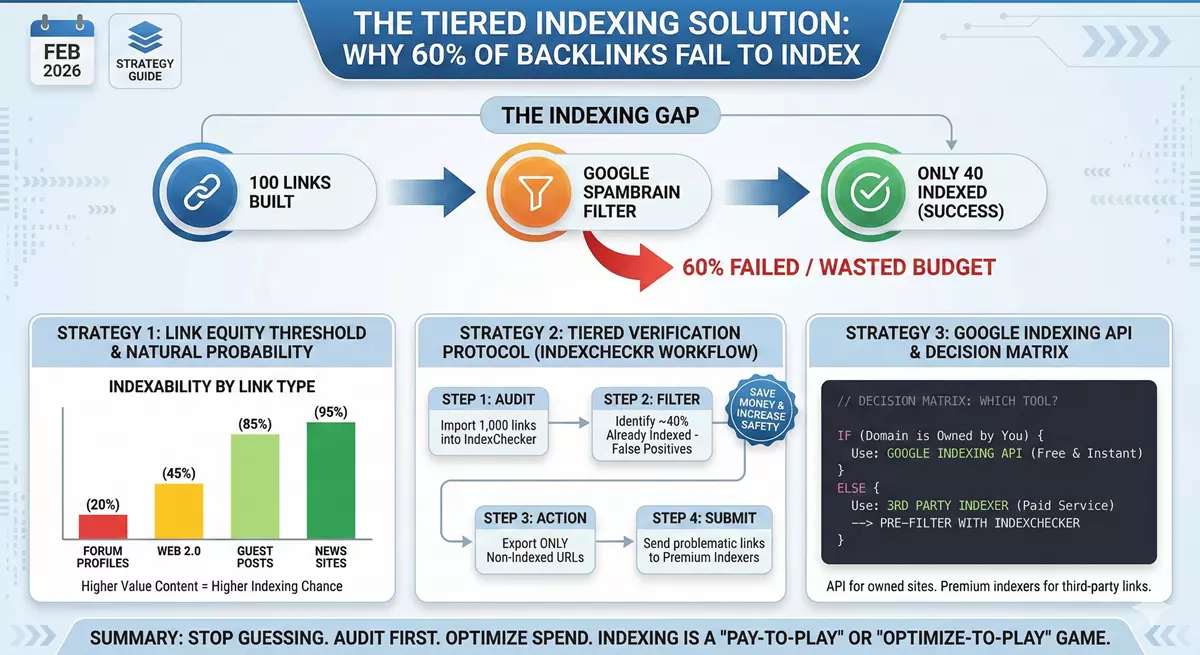
There's no single conclusive figure, however market information and professional experience regularly recommend someplace between 20% and 40% of backlinks in a normal campaign are never ever indexed by Google. The specific number depends heavily on the quality of links being built. Projects concentrated on high-authority, real-traffic placements will see better indexing rates than projects using mass Web 2.0 or directory site links.
What creates risk is aggressive or manipulative methods: submitting thousands of URLs simultaneously in patterns that look artificial, or utilizing networks of spam websites to generate phony crawl signals. When evaluating a service, look for one that publishes its method, offers per-URL reporting, and permits you to control submission speed.
Mastering SEO Crawl Optimization for Better RankingsFor bulk campaigns, you require a devoted index checker that accepts a list of URLs and returns indexed or not indexed status for each one. This is available as part of UltraIndexer's index examining product you can submit approximately 5,000 URLs per batch and get a clear, per-URL report back.
Crawled methods Googlebot has checked out the page and read its material. Indexed methods Google has actually processed and kept that page and, specifically for your backlink, evaluated the link, evaluated its quality, and linked it to your domain's trust chart. A page can be crawled and still not be indexed if Google chooses the material isn't worth saving.
Scaling Crawl Rates through Search Engine Models
Actions 4 through 6 of the indexing funnel at the start of this guide discuss exactly what happens after crawling.
Simply information. If you wish to index backlinks quickly without sending them all at as soon as, read our guide to drip feed indexing it covers why submission rate matters and how to set it up correctly for big campaigns. And if you're wanting to improve your indexing rate going forward, UltraIndexer's backlink indexing service includes drip feed scheduling, per-URL 7-day reporting, and transparent indexing rates by link type so you always understand what you're getting.
Backlinks are the backbone of SEO. You currently know this. However here's the uneasy reality that a lot of SEOs refuse to acknowledge: You can develop the most jaw-dropping, publisher-direct, DR90 link on a page with 40,000 month-to-month visitors, contextual positioning in the first sentence, handmade editorial content, best anchor text positioning but if Google never indexes the URL your link rests on? No authority transfer.
No ranking power. No movement. And the worst part? Many SEOs never even examine. They develop links and extol "Domain Score." They screenshot Ahrefs graphs and hold up shiny DR metrics like participation trophies. On the other hand, their links sit unindexed for weeks, months, often forever silently delivering no ROI, zero authority, and no signal strength.
Modern Position Tracking Systems to Grow
This is the complete breakdown on how to get your backlinks crawled, seen, and counted fast. It covers what works, what does not, and how to build a system that indexes your backlinks at scale.
When it comes to indexing backlinks, here's the variation that matters: the URL your link resides on the page your link the anchor + placement to the link to your domain's trust chart Up until all of these steps occur, your backlink is not a backlink. It is text on a page.
This is why indexes matter. Google doesn't treat "unindexed" like "pending." Google deals with "unindexed" like "irrelevant." This is precisely where most link-building projects break down. And if you're buying editorial PR, specific niche edits, authority placements, or high-cost visitor posts? Every unindexed link is money burning in real-time. Here are the genuine reasons most backlinks do not get indexed (and no, it's not since "Google is broken"): The linking page isn't crawled frequently (low crawl budget plan) The content is trash, spun, AI slop, or thin and the domain has actually overpublished for it's size The site has weak internal connecting (Googlebot never finds the page) The links are buried, concealed, or surrounded by spammy outbound links You haven't triggered any crawl worthy events (we'll speak about those later) Google prioritizes high value URLs for crawling.
Mastering SEO Crawl Optimization for Better RankingsYou've got to force Google to see them, process them, and designate value. That suggests actively indexing the links you've earned (or developed). Here are 7 fight checked methods I use across my own jobs, client campaigns, and when saving link profiles that should be working but aren't This is the fundamental method.
Yes, it still works, kind of If you own the site where the backlink lives (guest post, niche edit, web 2.0), then: Include the site to GSC (yes, you can confirm Web 2.0 subdomains) Paste the backlink URL into URL Evaluation Click Demand Indexing This sends out a crawl demand that generally sets off a see within 2472 hours.